AI APP BROKEN?
AI-built, vibe-coded, or traditionally developed — if your web app or MVP is broken, unstable, or stuck, App Rescue can help diagnose, repair, test, and stabilize it.
Human-directed, AI-assisted repair backed by technical testing and hands-on functional QA — because ‘the AI says it’s fixed’ isn’t good enough.
Sound Familiar?
Your app mostly work - until it doesn't. One bug turns into three. A fix breaks something else. The AI insists the problem is solved, but five minutes of actually using the app says otherwise.
App Rescue starts by establishing what the software is supposed to do, reproducing the failure, and finding the actual defect before we start changing things.
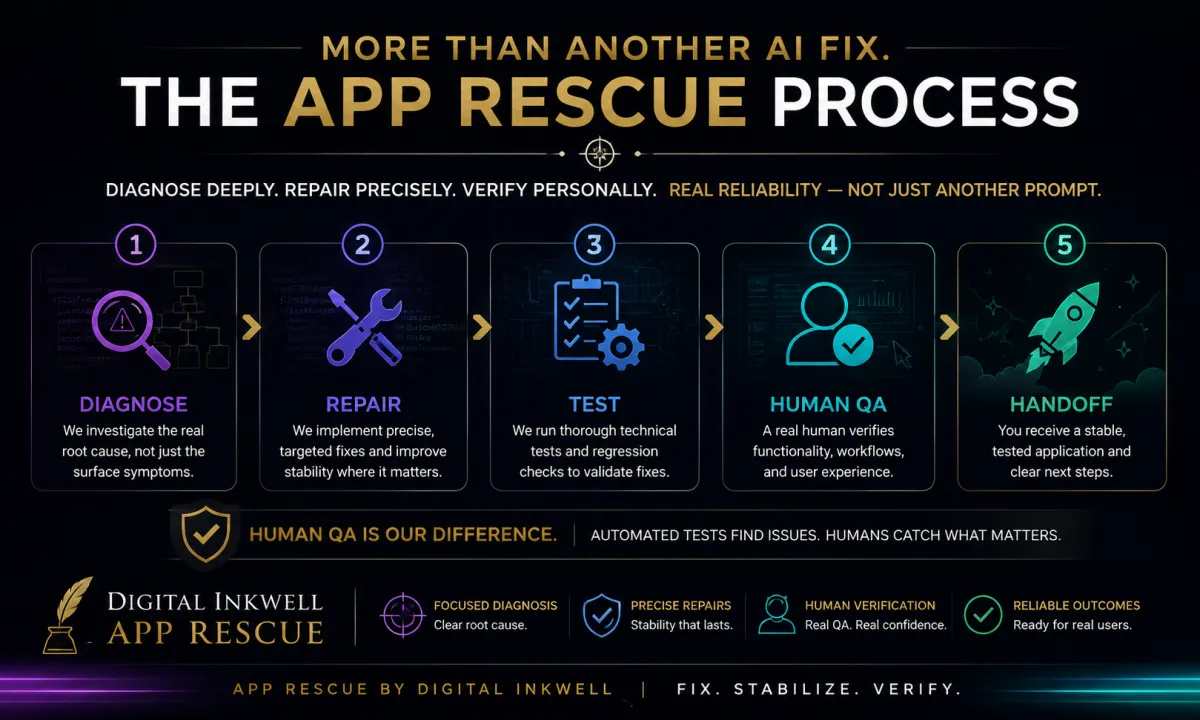
Repair is only part of the job. Technical testing and hands-on functional QA are what tells us whether the repair actually worked.
HOW APP RESCUE WORKS
Repair starts with understanding the failure — not blindly changing code.
ESTABLISH & REPRODUCE
Before changing code, we establish what the app is supposed to do and reproduce the failure. That gives us a real baseline instead of guessing from symptoms.
DIAGNOSE & REPAIR
Once the failure is reproducible, we trace the likely cause and make a bounded repair aimed at the agreed problem - not an uncontrolled rewrite of the project.
TEST & VERIFY
After the repair, we run relevant technical checks and then use the app by hand. Passing automated tests is useful; surviving real human use is the acceptance standard.
HANDOFF & BOUNDED REMEDIATION
If something within the agreed scope still fails reproducibly, the bounded remediation process handles it. New features, changed requirements, and unrelated defects are separate work.
WHICH RESCUE FITS?
Different failures need different depths of investigation.
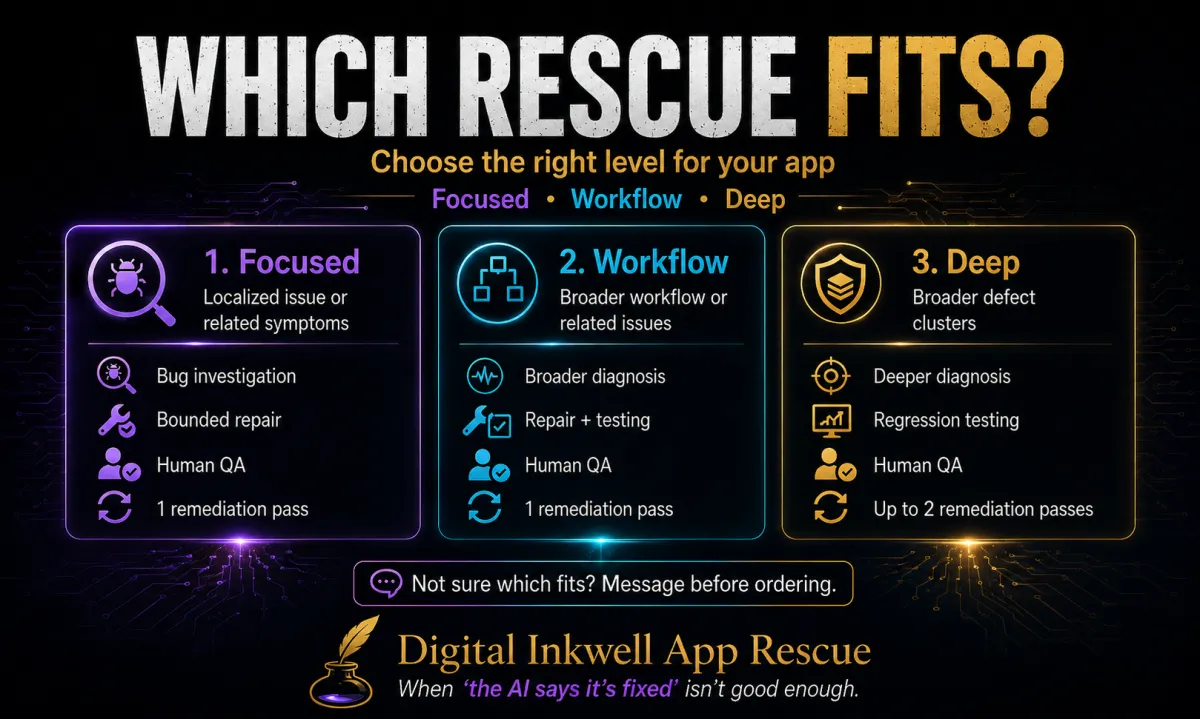
Focused Rescue is for a localized issue or related symptoms. Workflow Rescue is for a broader workflow or several connected problems. Deep Rescue is for broader defect clusters that need deeper diagnosis and testing.
Not sure which one fits? You do not have to guess. Message me on Fiverr before ordering and we can determine the appropriate scope.
HUMAN-DIRECTED. AI ASSISTED. ACCOUNTABLE
AI helps us move faster. It does not get the final vote.

App Rescue uses AI-Assisted development tools for engineering, testing, research and repair while retaining human direction, review, and responsibility. Automated testing helps us find problems. Hands-on function QA helps determine whether the repaired software actually works.
Every inherited codebase is different, and no responsible repair service can promise that every defect is discoverable or repairable. App Rescue is bounded to the agreed scope and intended behavior.
Deployment, hosting, database migration, DNS work, app-store submission, long-term maintenance, monitoring are separate unless specifically agreed.
READY TO RESCUE YOUR APP?
View the App Rescue Gig for current packages, details, availability, and messaging.